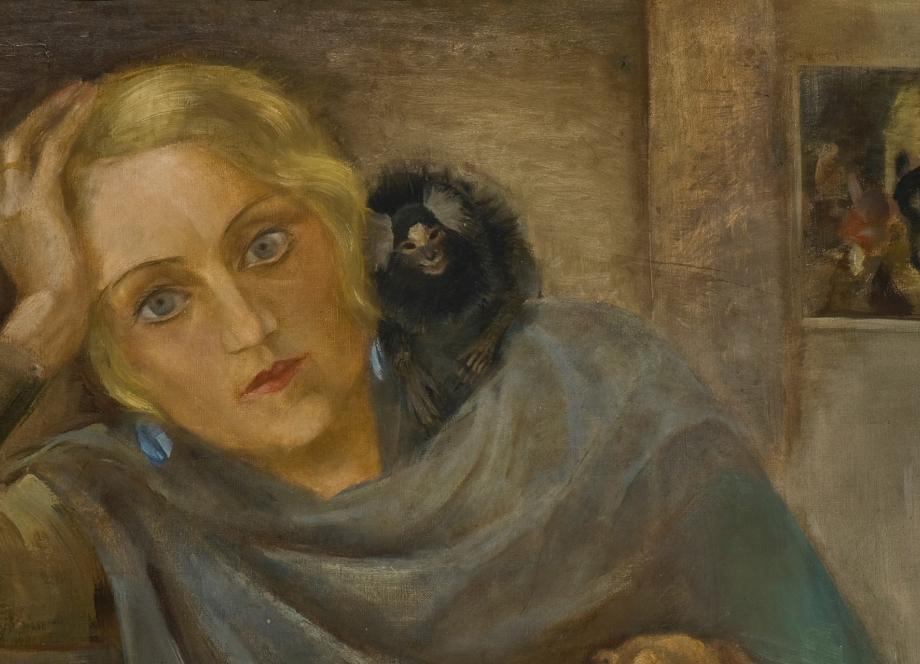
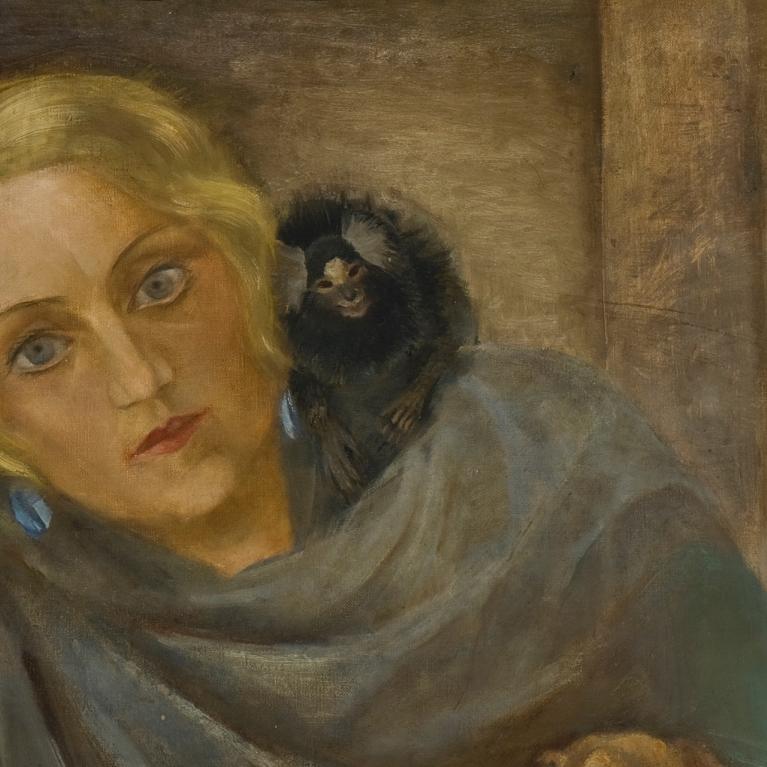
From 3 March 2026 to 27 February 2027, the exhibition Melancholia imaginativa is on view at the Romans Suta and Aleksandra Beļcova Museum in Riga (Elizabetes iela 57a, Apt. 26), revealing the peculiarities of characters in Aleksandra Beļcova’s portrait painting.
3 March 2026 – 27 February 2027
The Romans Suta and Aleksandra Beļcova Museum
Elizabetes iela 57a, Apt. 26
(entry through the courtyard, 5th floor), Riga
The theme of melancholia has a long history in European art. In ancient times, “melancholia” (from Greek “black bile”) was considered to not only be a peculiarity characteristic of one of the temperaments, but also an affliction which negatively affects a person’s thinking and psyche. The Renaissance changed the attitude of thinkers and artists towards melancholia, coming to see it as a mark of a genius, thinker, scientist. The Italian philosopher Marsilio Ficino termed this type of melancholia “Melancholia imaginativa”.
The tradition of depicting melancholy characters in art has been developing since antiquity. Ariadne abandoned by Theseus and Penelope waiting for her Odysseus, or the image of Melancholia from Albrecht Dürer’s famous engraving – all of these figures have a certain iconography. It is the so-called “thinker’s pose”: sitting with head supported by one hand, hands crossed on the chest, head slightly bowed, eyes downcast – mentioned attributes unmistakably pointed to the link between the character and melancholia.
In the portraits painted by Aleksandra Beļcova (1892–1981) this tradition acquires an individual inflection. The vicissitudes of the artist’s life, her prolonged battle with tuberculosis and, to some extent, a tendency towards introversion determined the rendition of the characters that fits into the described typology. In both self-portraits and those of others Beļcova foregrounded a mood of light sadness. Even the comic actress Anta Klints is depicted by the artist in one of the portraits in a characteristic melancholy pose. Later, already in the 1950s, Beļcova envisioned showing Anta Klints at work, but the painted composition presents the actress sitting half-reclined on the sofa in a pensive moment, letting her hand with the pencil hang loose and not looking at the papers, texts on her lap. In a similar manner, the melancholy-stricken philosophers and scientists in the works of the old masters or the winged creative spirit from Dürer’s engraving ignore their tools of trade and pensively wait for inspiration.
In the 1930s, a melancholy mood had settled over several European metropolises. It is noted by the German philosopher Walter Benjamin and the French sociologist Émile Durkheim in their writing about Berlin and Paris. One of the key novels of this time – Jean-Paul Sartre’s Nausea – to a large extent embodied this Zeitgeist. It is noteworthy that according to the author’s original intention it was to be called Melancholia. The rapid industrialisation, the coming to power of totalitarian regimes in Europe and Russia led to the substitution in the 1930s of the carefree flânerie, which was characteristic of the late 19th and early 20th centuries, with the new type of city-dweller who lives under the spell of melancholia.
In connection to the theme of the exhibition, a find in the personal library of Aleksandra Beļcova becomes worthy of attention. Inserted in a brochure of the Constitution of the LSSR (1940) was a page with a quote from French writer François-René de Chateaubriand’s novel Les Martyrs. In the typewritten fragment, the main protagonist says goodbye to Muse – the symbol of youth and inspiration – and accepts the next stage of his creative path, which from now on will tell about the bitterness of loss (Part 2, Chapter 24 of the novel). The quote from Chateaubriand may suggest that Beļcova had an affinity for Romanticism’s characteristic understanding of melancholia as a special trait of the personality of a creative individual. At the same time, it hints that the Soviet period brought the artist many trials and disappointments, which must have had an effect on the message and mood of her works.
The exposition offers a brief look at the history of the concept of melancholia and the iconography of melancholy characters, giving visitors the opportunity to see previously unexhibited works by Aleksandra Beļcova as well as already familiar portraits, which acquire new resonance in the context of the theme.
Text by Natalya Yevseyeva
Exhibition curator:
Dr. art. Natalya Yevseyeva
Head of the Romans Suta and Aleksandra Beļcova Museum /
Latvian National Museum of Art
Ph: (+371) 67 288 800
E:

